
WHY ADD PEPTIDES TO YOUR CLIENT'S SKINCARE REGIMEN?
When clients ask about peptides, it's a great sign; it means they're engaged and invested in their skin health. The question "what do peptides do for skin?" deserves a thorough, well-informed answer.
Let’s break down what peptides are, how the different categories work and how to match them to your clients' specific concerns. Then we can walk through the GlyMed+ formulations that put each one to work.
WHAT ARE PEPTIDES AND WHAT DO THEY ACTUALLY DO FOR SKIN?


Peptides are short chains of amino acids, the same building blocks that form larger structural proteins like collagen and elastin. If amino acids are connected in the right sequence, you get a peptide; link many together, and you get a full protein. This fundamental relationship is exactly why what peptides do for skin plays such an important role in supporting how skin ages and recovers over time.
Depending on their structure, peptides can play different roles, including:
- Improving the appearance of firmness and elasticity
- Supporting extracellular matrix processes (the structural framework beneath the skin's surface)
- Helping reduce the visible appearance of fine lines
- Boosting hydration and barrier function
- Providing antioxidant or environmental support depending on the formulation
A NOTE ON PEPTIDE INJECTIONS
With peptide injectables making headlines lately, you may already be hearing more questions about them from your clients. While unapproved peptide injections lack solid scientific backing, this growing curiosity is a wonderful opportunity for education.
Your clients are already thinking about how peptides interact with the body. That's the perfect foundation for helping them understand how topically applied peptides can support their skin in a more targeted, evidence-based way.
THE MAIN FUNCTIONAL CATEGORIES OF PEPTIDES
Not every peptide does the same thing for the skin. To make sure you're intentional about your product selections, read through these different categories.
SIGNAL PEPTIDES
Signal peptides act like messengers. They communicate directly with fibroblasts and other skin cells to stimulate many different mechanisms, including the production of collagen, elastin and glycosaminoglycans like Hyaluronic Acid.
Examples
- Palmitoyl Tetrapeptide-7 and Palmitoyl Tripeptide-1 or Matrixyl 3000
- Palmitoyl Pentapeptide or Palmitoyl Pentapeptide‑4 (Matrixyl)
- Oligopeptide-34, or Lumixyl
- Palmitoyl Tripeptide-38 (Matrixyl Synthe'6)
CARRIER PEPTIDES
Carrier peptides don't focus on the skin directly. Instead, they bond to essential minerals and deliver or transport them deeper into the skin.
Examples
- Copper Tripeptide-1 or GHK-Cu
- Manganese Tripeptide-1
NEUROTRANSMITTER PEPTIDES
These peptides target expression lines specifically. Movements like smiling, squinting or furrowing brows that are repeated over the years can leave lasting lines. Neurotransmitter peptides can temporarily reduce the intensity of those contractions, softening the appearance of lines around the eyes, mouth and forehead.
Examples
- Acetyl Glutamyl Heptapeptide-1 or SNAP-8
- Pentapeptide-18 or Leuphasyl
- Acetyl Hexapeptide-3 or Argireline
- Dipeptide Diaminobutyroyl Benzylamide Diacetate
PROTECTIVE PEPTIDES
Protective peptides work as antioxidants at a cellular level. They neutralize free radical damage and support the skin's internal aging processes.
Examples
- Palmitoyl Tripeptide-1 or Palmitoyl Tetrapeptide-7
- Copper Tripeptide-1
- Acetyl SH-Heptapeptide-1
REGENERATIVE PEPTIDES
Regenerative peptides support cellular turnover and desquamation to encourage better skin quality. Some of these support exfoliation, while others encourage keratinocyte proliferation and migration.
Examples
- Hexanoyl Dipeptide-3 Norleucine Acetate
- Pentapeptide-48
ENZYME-INHIBITING PEPTIDES
Enzyme-inhibiting peptides help protect skin integrity by targeting specific enzymes that contribute to collagen breakdown, inflammation and pigmentation. These peptides can maintain a healthy, vibrant complexion by supporting the skin’s natural structures and inhibiting processes that degrade its appearance.
Examples
- Trifluoracetyl Tripeptide-2
- Palmitoyl Tetrapeptide-7
- 1-Methylhydantoin-2-Imide
WHY THE SPECIFIC PEPTIDE AND FORMULATION MATTER
Seeing "peptides" on an ingredient list tells you very little about how a product will actually perform. For a meaningful clinical assessment, you need to consider:
- Which peptide is being used
- Its intended mechanism
- Chemical and physical properties
- Delivery system
- Concentration
- Supporting ingredients
- The complete formulation context
For example, differences in molecular weight can cause peptides to vary significantly in their ability to penetrate the barrier and reach their intended dermal target. Larger peptide molecules may remain on the surface unless they're lipid-bound (like palmitoyl-group peptides) or delivered through a well-designed vehicle.
A great peptide in a poorly formulated base often won't perform the way you'd expect. While you're reviewing formulations, ask yourself whether the delivery system supports the peptide's mechanism or works against it.
MATCHING PEPTIDES TO YOUR CLIENT'S SKIN CONCERNS
Once you understand the categories and what these peptides do for the skin, matching peptides to client goals becomes much more straightforward.
EARLY SIGNS OF AGING AND PREVENTION-FOCUSED CLIENTS
For younger clients or those focused on prevention, signal and carrier peptides are your starting point. These support the skin's natural production of structural proteins before visible changes become significant.
Recommendations:
FINE LINES AND LOSS OF FIRMNESS
Signal peptides that stimulate collagen production and support the extracellular matrix are the primary consideration here, especially formulas that combine complementary peptide types for broader coverage.
Recommendations:
EXPRESSION LINES
Neurotransmitter peptides are the category to reach for when movement-driven lines around the forehead, eyes and mouth are the primary concern.
Recommendations:
CLIENTS NEEDING MORE SUPPORTIVE REGIMENS
For clients with compromised barriers, post-treatment sensitivity or skin that doesn't tolerate stronger actives well, carrier and protective peptides offer a gentler but still effective pathway to results.
Recommendations:
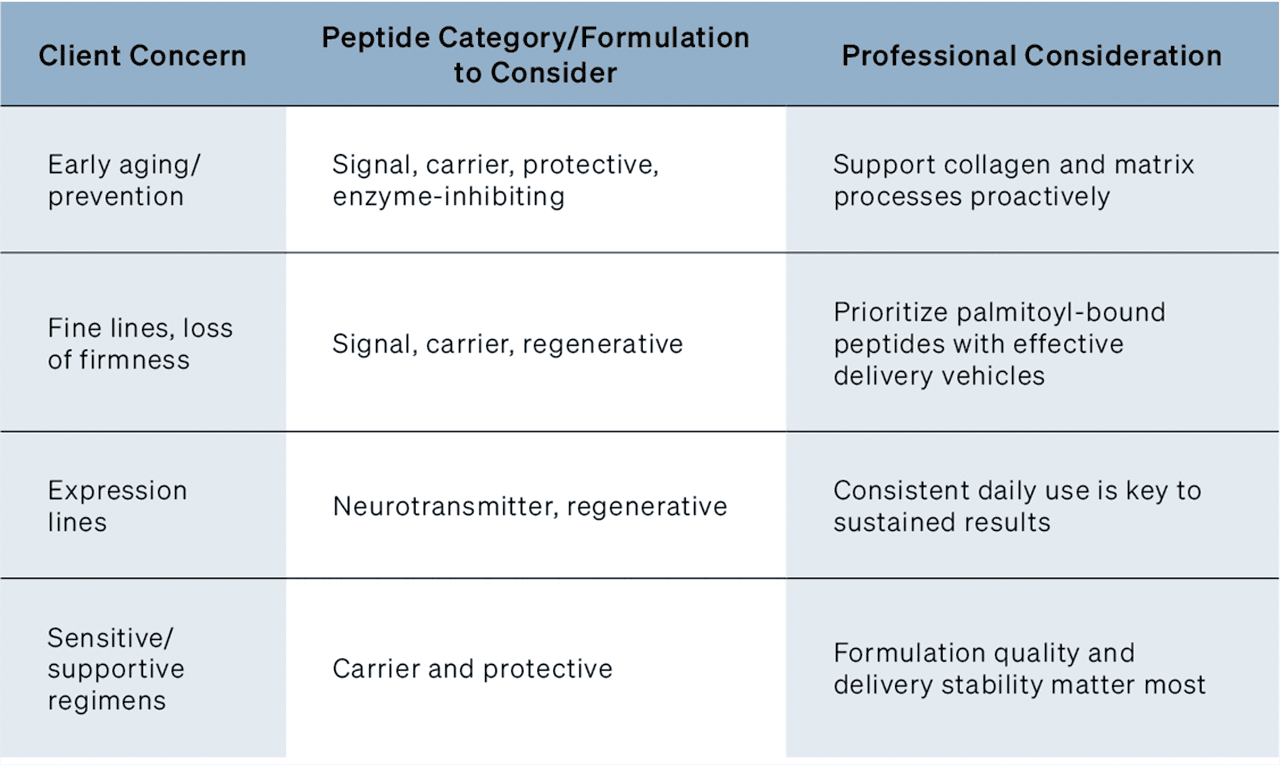
QUICK REFERENCE TABLE
HOW TO INCORPORATE PEPTIDES INTO A CLIENT'S REGIMEN

Peptides play well with most actives, including Retinol and Vitamin C, and are generally well-tolerated across all skin types and Fitzpatrick levels. That said, simply adding a product because it contains peptides isn't always the best approach. Before making any recommendations, start with a thorough skin assessment and let your client's specific needs guide the way.
A clear process helps keep regimen decisions focused:
- Start with your client's primary goal: Firmness, expression lines, barrier support or prevention?
- Evaluate the existing routine: Identify gaps and potential ingredient conflicts
- Choose the appropriate product format: Serum, moisturizer, masque or cleanser based on skin needs and lifestyle
- Give every product a clear purpose: Every step should address something specific
FREQUENTLY ASKED QUESTIONS
DO YOU NEED TO USE PEPTIDES EVERY DAY TO SEE RESULTS?
Yes, consistent daily use is recommended for best results. Peptides work cumulatively by supporting ongoing skin processes, not by producing an immediate visible change, so skipping days slows progress. Most peptide products are formulated for morning and/or evening use to make consistent application easy.
DO YOU NEED MORE THAN ONE PEPTIDE PRODUCT IN A REGIMEN?
Not necessarily; it depends on your client's concerns and the formulation. A well-formulated product that combines complementary peptide types can address multiple concerns effectively on its own. Multiple products make more sense when a client has distinct concerns calling for different categories.
ARE HIGHER CONCENTRATIONS OF PEPTIDES ALWAYS MORE EFFECTIVE?
No, concentration alone doesn't determine efficacy. What a peptide does for the skin depends equally on its molecular weight, stability and delivery system. A lower-concentration peptide in an optimized formulation can outperform a higher concentration in a poorly designed base.
AT WHAT AGE SHOULD YOU START USING PEPTIDES?
There's no set age because peptides are appropriate at multiple life stages. Clients in their 20s can benefit preventatively, particularly from signal peptides that support collagen production before visible aging begins. Those with established concerns may benefit from more targeted category combinations based on specific signs.
CAN YOU USE PEPTIDES ALONGSIDE SEVERAL ACTIVE INGREDIENTS?
Yes, peptides are generally compatible with most actives, including Retinol and Vitamin C. Because they support the skin's natural processes rather than introducing harsh chemistry, they tend to layer well in multi-active regimens.
TAKE YOUR PEPTIDE KNOWLEDGE FURTHER WITH GLYMED+
Understanding what peptides do for skin at a formulation level and not just a surface level is what separates a confident professional recommendation from a generic one. GlyMed+ offers a professional-grade peptide portfolio built on ingredient transparency and clinical-grade standards, paired with the education to help you apply it effectively.
Become a GlyMed+ Professional to access in-depth training, exclusive resources and a product line designed to support the work you do every day!
BECOME A GLYMED+ PROFESSIONAL
Like this content? Thousands of licensed skincare professionals have discovered the benefits of becoming a GlyMed+ Pro. Now's the time to join an elite group of estheticians dedicated to providing the best skincare services using the most effective products.
Click below to begin your GlyMed+ partnership and take your skincare business to new heights!
Become a ProSUPPORTING SKINCARE PROFESSIONALS
All GlyMed+ products are sold through licensed professionals to ensure product integrity and proper skincare instruction. As you work with a GlyMed+ Professional, you’ll receive personalized skincare treatments and home care regimens to help you achieve your skin goals.
Contact Your Local GlyMed+ ProFOLLOW US @GLYMEDPLUS
STAY CONNECTED
Enter your email to get the latest news, tips and deals straight to your inbox